Verdict at a glance
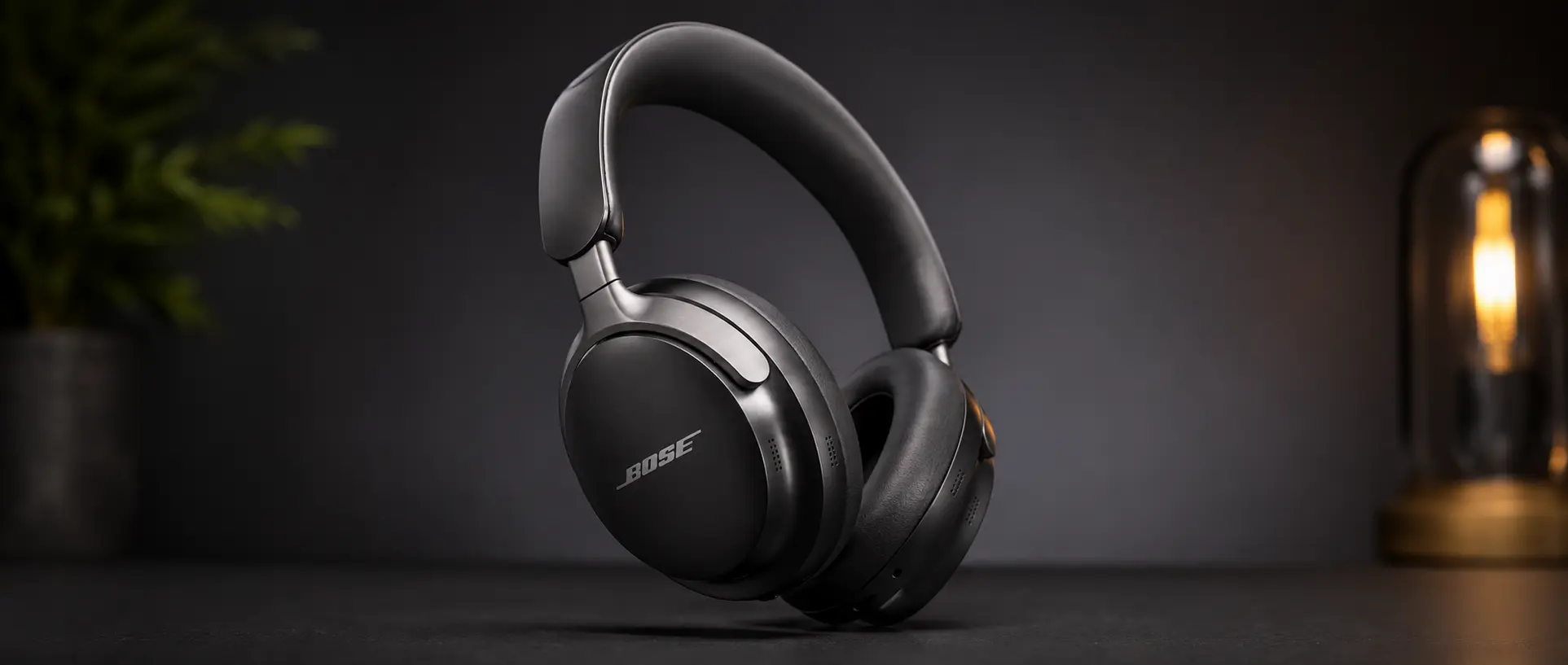
Bose QuietComfort Ultra Headphones (2nd Gen) — rated very good at 85/100
The second-generation QuietComfort Ultra is a targeted refresh rather than a redesign, and it lands almost every punch it aims for. Battery life climbs from 24 to 30 hours with ANC on, USB-C now carries lossless 16-bit/44.1 or 48 kHz audio, the noise cancelling can finally be turned off or dialled down by hand, and a new Cinema Mode extends the spatial processing to video and podcasts. The noise cancelling itself remains the best we have measured — TechGearLab records a 32.3 dB broadband average, including 40.2 dB in the highs. What has not changed is the tuning: a bass-forward, slightly veiled house sound that trails the Sony WH-1000XM6, Bowers & Wilkins Px7 S3 and Sennheiser HDB 630 at the same money.
- Price:
- $399
- Maker:
- Bose
Announced 10 September 2025 and on sale from 2 October 2025 at $449. Bose.com now lists the QCUH2-HEADPHONEARN at $399 as a reduction from $449; Amazon street pricing has been running around $379.
+Pros
- Best-in-class noise cancelling — a 32.3 dB broadband average that effectively erases cabin and HVAC noise
- Exceptional comfort: light clamp, protein-leather cushions and a 9.5/10 comfort score from TechGearLab
- Battery jumps from 24 to 30 hours with ANC on, plus 45 hours with ANC off and a 15-minute/3-hour fast charge
- New USB-C lossless audio at 16-bit/44.1 or 48 kHz, and you can listen while charging
- Immersive Audio plus the new Cinema Mode is the most convincing spatial implementation among ANC flagships
- Folding design with a solid case, Bluetooth 5.4 multipoint and aptX Adaptive via Snapdragon Sound
−Cons
- Sound quality trails the Sony WH-1000XM6, B&W Px7 S3 and Sennheiser HDB 630 at the same or lower price
- Only a three-band EQ — no parametric or ten-band control like Sony's app offers
- No passive wired mode: the bundled 3.5 mm to 2.5 mm cable still requires battery power
- Call quality is mediocre, and Trusted Reviews flags it specifically
- Aware mode has an audible white-noise hiss, there is no IP rating, and the design is only incrementally new
01Price, positioning and what actually changed
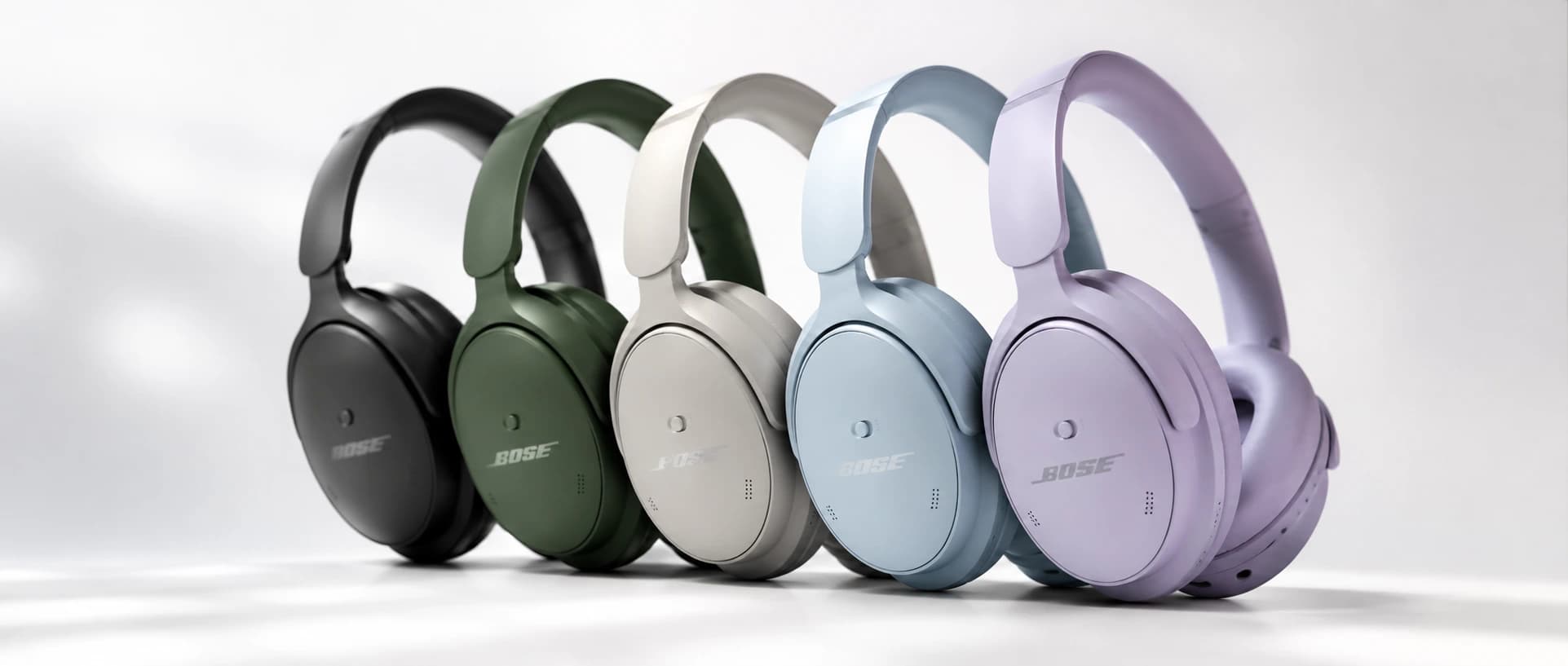
Bose announced the second-generation QuietComfort Ultra Headphones on 10 September 2025 and put them on sale on 2 October at $449, the same launch price as the model they replace. As of August 2026 Bose.com lists the QCUH2-HEADPHONEARN at $399, presented as a reduction from $449, and Amazon street pricing has been running around $379. That puts the headphones $50 below the Sony WH-1000XM6 and Bowers & Wilkins Px7 S3 at list, and $100 below the Sennheiser HDB 630. Five finishes are available: Black, White Smoke, Midnight Violet, Driftwood Sand and Desert Gold.
The changes are a list rather than a rethink. Battery life goes from 24 to 30 hours with ANC engaged. USB-C now carries digital audio at 16-bit/44.1 or 48 kHz, so the headphones can be used as a wired lossless output rather than only a charging endpoint. The ANC is now fully defeatable and manually adjustable on a slider in the app, which the first generation notably would not allow. A new Cinema Mode joins Immersive Audio and spatialises video and podcast content instead of only music.
Everything else is carried over, and that is the crux of the review. The industrial design, the folding mechanism, the case, the touch strip and the CustomTune ear calibration are all recognisably gen 1. Bose has not published a driver diameter for either generation; TechGearLab's teardown-style measurement puts it at 35 mm, and we treat that as a third-party figure rather than a specification. Whether a feature list of this shape justifies flagship pricing depends almost entirely on how much you value the one thing Bose does better than anyone.
02Design, comfort and controls
Bose lists the headphones at 0.583 lb and TechGearLab measured 265 g on their own scale, so 264-265 g is the figure to work from; some outlets have cited 250 g, which we could not reproduce and are not using. That makes the QuietComfort Ultra heavier than the Sony WH-1000XM6 but meaningfully lighter than the Px7 S3 and HDB 630, both of which are around 300 g. More important than the absolute number is how the mass is carried: the clamping force is light, the protein-leather cushions are deep, and the headband spreads load well enough that ten-hour sessions do not become an endurance test. TechGearLab awarded 9.5/10 for comfort, the highest in their 26-headphone group, and our experience matches that.
The earcups fold flat and inward into the included carry case, which remains one of the better cases in the category and one of the few genuine practical advantages over the Sony and B&W alternatives. Build quality is solid without being showy: matte plastics, a metal-reinforced headband slider, and no creaking under torsion. There is no IP rating of any kind, so these are not headphones to take to the gym or wear in rain, and Bose does not claim otherwise. For a $399 product that will spend its life in bags and on aircraft tray tables, the absence of any ingress specification is a fair criticism.
Controls are a hybrid and they work better than most. A power and Bluetooth button and a multi-function button handle the discrete tasks, while a capacitive touch strip on the right cup handles volume and user-assigned shortcuts. On-head detection pauses playback reliably, and the headphones can store up to ten saved listening modes that you cycle through with the multi-function button. Google Fast Pair and Spotify Tap are both supported, and the touch strip is precise enough that we stopped reaching for the phone.
- Measured weight 265 g (TechGearLab); Bose lists 0.583 lb
- Folds flat and inward into the included hard carry case
- Capacitive touch strip for volume and shortcuts, plus power/BT and multi-function buttons
- On-head detection with auto pause and resume
- Up to 10 saved listening modes, cycled from the multi-function button
- No IP rating — not specified for dust or water resistance
03Noise cancelling: the category leader, measured
This is where the money goes. TechGearLab's measurements put attenuation at 26.5 dB in the low frequencies, 30.2 dB through the midrange and 40.2 dB in the highs, for a broadband average of 32.3 dB. Those are the highest figures in their comparison group and they translate directly into the subjective experience: aircraft cabin rumble does not merely recede, it stops being a thing you are aware of, and office HVAC drone disappears entirely. SoundGuys, using their own weighting, scored isolation 7.1/10 — a different scale, but the same ranking relative to rivals.
The next-generation ActiveSense system also handles transients better than most. Sudden loud events — a door slamming, a train announcement, a colleague dropping a laptop bag — are clamped without the pumping artefact that cheaper adaptive systems produce. Quiet mode is the full-strength setting, Aware is the transparency mode, and everything in between is now available as a manual slider, which is the single most requested change from the first generation and the one Bose delivered most completely. You can also switch ANC off entirely, something gen 1 simply would not do.
Aware mode is the weak spot. Transparency is natural in timbre and pleasant for conversation, but there is an audible white-noise hiss underneath it, particularly in a genuinely quiet room. It is not severe enough to make the mode unusable, and it is largely masked once there is any ambient sound at all, but it is a step behind the cleanest transparency implementations. Given that Bose wins the active cancelling comparison this decisively, the hiss reads as an odd blemish rather than a dealbreaker.
Noise reduction by frequency band
dB reduction — higher is betterSource: TechGearLab measurements
04Sound quality, CustomTune and the three-band EQ
Bose does not publish a frequency response for these headphones, so the best available reference is SoundGuys' measurement, which shows a bass-tilted curve running roughly 3 to 6 dB above their house target through the low end, extension out to 20 kHz, and an uneven region between 3 and 8 kHz. That description matches what we heard: a warm, full, easy-listening presentation with plenty of weight under electronic and pop material, and a slightly recessed, occasionally glassy upper midrange that costs the headphones detail on acoustic and vocal-led recordings. It is a tuning designed to sound impressive immediately and to survive noisy environments, which is a coherent choice for a travel headphone.
The problem is the comparison set. What Hi-Fi and Trusted Reviews both landed on 4/5 and both explicitly deducted for sound relative to price, pointing at the Sony WH-1000XM6, Bowers & Wilkins Px7 S3 and Sennheiser HDB 630 as better performers at the same or lower money. TechGearLab, which ranked the headphones first overall at 88/100, still scored sound 8.6 against 9.2 for ANC and 9.5 for comfort. The consensus is unusually tidy: Bose keeps the noise cancelling crown and does not take the sound crown.
CustomTune, which calibrates output to the shape of your ear canal at each power-on, does real work here and makes the seal-dependent bass response far more consistent between users than it would otherwise be. What it cannot do is compensate for the limited correction available afterwards. The app offers a three-band EQ — bass, mid, treble — and nothing more granular, so if the 3-8 kHz unevenness bothers you, there is no tool to address it. Sony's parametric approach and the ten-band controls on several rivals make this feel dated on a 2025-generation flagship.
05Battery, charging and the new USB-C lossless path
Bose claims 30 hours with ANC on, 45 hours with ANC off and 23 hours with Immersive Audio engaged — the first figure being a six-hour improvement over the first generation. SoundGuys' standardised battery test returned 27 hours 12 minutes, roughly 9% short of the claim, which is a normal shortfall for this class of test and still a strong result. Trusted Reviews reported around 10% drain over three hours at 50% volume, which extrapolates to the claimed 30 hours being within reach in ordinary listening. Our own use fell between the two, and the practical takeaway is that a week of commuting or a long-haul return trip fits comfortably inside one charge.
Charging is over USB-C, with a full cycle taking about three hours and a 15-minute top-up returning about three hours of playback. The more interesting change is that the headphones are now wearable while charging, which combined with USB-C audio input turns them into a viable desk headphone for a laptop. That USB-C path carries lossless 16-bit audio at 44.1 or 48 kHz, and it is the headline addition of this generation for anyone who found gen 1's Bluetooth-only limitation frustrating.
The analogue side is less generous. Bose includes a 3.5 mm to 2.5 mm cable, but it requires battery power to function — there is no passive mode, so a flat pair of QuietComfort Ultra headphones is silent regardless of what you plug into it. For a product aimed squarely at air travel, where seat-back systems are still analogue and outlets are unreliable, that remains a real limitation and one several rivals do not share. Wireless connectivity is otherwise strong: Bluetooth 5.4 with roughly a 30 ft range, SBC, AAC and aptX Adaptive via Snapdragon Sound, and two-device multipoint managed from the app.
Battery life with ANC enabled
hours — higher is betterSource: Bose measured figure from SoundGuys; rival figures are manufacturer claims
06Immersive Audio, Cinema Mode, the app and call quality
Immersive Audio remains Bose's head-tracked spatial system, and it is still the most convincing implementation among ANC flagships — Digital Trends and What Hi-Fi have both said as much. It widens the stage without the hollow, phase-smeared quality that most virtualisers introduce, and the head tracking anchors the image to the device rather than your skull in a way that feels natural after a few minutes. The cost is battery: 23 hours instead of 30. New for this generation is Cinema Mode, which applies the same spatialisation to video and podcast content rather than music only, and it is the more useful of the two for long flights.
The Bose app is comprehensive without being cluttered. It handles CustomTune calibration, the three-band EQ, the ANC level slider, shortcut mapping for the touch strip, the multipoint manager, a per-cup battery readout and over-the-air firmware updates. Mode management is the strongest part: you can build and store up to ten configurations combining ANC level, EQ and spatial settings, then cycle them from the headphones without touching the phone. The EQ ceiling is the only serious complaint, and it is a significant one for a headphone at this price.
Call quality is the clearest functional weakness. Bose does not disclose the microphone count, describing the system only as a beamforming array with echo reduction, and in practice callers described our voice as thin and noticeably processed in anything busier than a quiet room. Trusted Reviews flags the same thing specifically, and it is the one area where a $200 headphone will often do better. If your headphones double as a conferencing device for several hours a day, this is the detail that should push you toward a rival.
07How it compares
The competitive picture in mid-2026 is unusually clean, because each rival wins a different category. The Sony WH-1000XM6 matches the 30-hour battery claim, is lighter at around 254 g, adds LDAC and offers far deeper EQ control, and most reviewers place its tuning ahead of the Bose. The Bowers & Wilkins Px7 S3 pairs a 40 mm driver with aptX Adaptive and aptX Lossless and is the choice for listeners who care most about fidelity, at the cost of around 300 g on the head. The Sennheiser HDB 630 asks $499 but claims roughly 60 hours, twice anything else here, alongside a 42 mm driver and aptX Lossless.
None of them cancels noise as well. That is the whole argument, and whether it wins depends on the room you sit in. For someone flying twice a month or working next to an air handler, 32.3 dB of broadband reduction is worth more than a better-behaved 4 kHz region, and the comfort score means you can actually wear the thing for the full flight. For someone listening at a desk in a quiet home, the calculus inverts completely and the Px7 S3 or the XM6 is straightforwardly the better headphone for the money.
It is also worth weighing the two things Bose does that the spec sheet undersells: the folding case-friendly design, which none of the three rivals matches for packability, and Immersive Audio with Cinema Mode, which is the only spatial system in this group we would leave switched on. Set against that, the lack of a passive wired mode and the mediocre microphones are the two places where the QuietComfort Ultra is beaten by cheaper products. Our 85 reflects a headphone that is decisively first in one dimension and mid-pack in another.
Head to head
| Specification | Bose QC Ultra 2nd Gen | Sony WH-1000XM6 | B&W Px7 S3 | Sennheiser HDB 630 |
|---|---|---|---|---|
| Price | $399 (from $449) | $449 | $449 | $499 |
| Battery, ANC on | 30 h claimed / 27 h 12 min measured | 30 h | 30 h | ~60 h |
| Driver | 35 mm (third-party measurement) | 30 mm | 40 mm | 42 mm |
| Codecs | SBC, AAC, aptX Adaptive | LDAC | aptX Adaptive / aptX Lossless | aptX Adaptive / aptX Lossless |
| Weight | 265 g measured | ~254 g | ~300 g | ~308 g |
| Wired options | USB-C lossless 16/44.1-48 + 3.5 mm (needs power) | Analogue and USB-C | Analogue and USB-C | Analogue and USB-C |
| Measured ANC | 32.3 dB broadband average | Not re-measured here | Not re-measured here | Not re-measured here |
Full specifications
Audio and codecs
| Driver | 35 mm — third-party measurement by TechGearLab; Bose does not publish a figure |
|---|---|
| Frequency response | Not published by Bose; SoundGuys measured extension to 20 kHz with a bass tilt of ~3-6 dB over their house curve |
| Codecs | SBC, AAC, aptX Adaptive (Snapdragon Sound) |
| Wired digital | USB-C lossless, 16-bit/44.1 kHz or 48 kHz |
| Wired analogue | 3.5 mm to 2.5 mm cable included — requires battery power, no passive mode |
| Spatial audio | Immersive Audio with head tracking, plus Cinema Mode for video and podcasts |
| Calibration | CustomTune ear-shape calibration at each power-on |
Noise cancelling and modes
| System | Next-generation ActiveSense adaptive ANC |
|---|---|
| Modes | Quiet, Aware, Immersive Audio, Cinema Mode, plus custom modes |
| Manual control | ANC level slider in the app; can be fully disabled |
| Low-frequency reduction | 26.5 dB (TechGearLab) |
| Midrange reduction | 30.2 dB (TechGearLab) |
| High-frequency reduction | 40.2 dB (TechGearLab) |
| Broadband average | 32.3 dB (TechGearLab); SoundGuys isolation score 7.1/10 |
Battery and charging
| Claimed runtime, ANC on | 30 hours — up from 24 hours on the first generation |
|---|---|
| Claimed runtime, ANC off | 45 hours |
| Claimed runtime, Immersive Audio | 23 hours |
| Measured runtime | 27 hours 12 minutes in SoundGuys' standardised test |
| Full charge | About 3 hours via USB-C |
| Fast charge | 15 minutes for about 3 hours of playback |
| Charge while wearing | Yes — new for this generation |
Design, controls and connectivity
| Weight | 264-265 g (Bose lists 0.583 lb; TechGearLab measured 265 g) |
|---|---|
| Folding | Flat and inward, into the included carry case |
| Controls | Power/Bluetooth button, multi-function button, capacitive touch strip, on-head detection |
| Saved modes | Up to 10, cycled from the multi-function button |
| Bluetooth | 5.4, roughly 30 ft range, Google Fast Pair, Spotify Tap |
| Multipoint | 2 devices, managed in the app |
| Microphones | Beamforming array with echo reduction; count not disclosed by Bose |
| Durability / colours | No IP rating · Black, White Smoke, Midnight Violet, Driftwood Sand, Desert Gold |
Verdict
Bose set out to fix a specific list of gen 1 complaints and worked through it methodically. The battery claim moves from 24 to 30 hours with ANC engaged, and 45 hours with it off; SoundGuys' standardised test returned 27 hours 12 minutes, which is short of the claim but in the same territory, and Trusted Reviews saw roughly 10% drain over three hours at 50% volume. USB-C audio is new and genuinely useful — it accepts lossless 16-bit/44.1 or 48 kHz and lets you keep listening while the headphones charge, which closes the most-cited omission of the first generation. The ANC circuit is now fully defeatable and manually adjustable in the app, so the headphones no longer insist on processing your music when you do not want them to.
The noise cancelling is the reason to buy these and it is not close. TechGearLab measured 26.5 dB of reduction at low frequencies, 30.2 dB through the mids and 40.2 dB in the highs, for a 32.3 dB broadband average, and ranked the headphones first out of 26 over-ears at 88/100 with a 9.5/10 comfort score. In practice that means aircraft cabin rumble and office HVAC effectively disappear rather than merely receding, and the light clamping force plus protein-leather cushions make ten-hour sessions realistic. SoundGuys scored isolation 7.1/10 on their own scale and the headphones 8.2/10 overall, while Digital Trends simply called them the noise-cancelling champ.
The reservation is sound per dollar, and it is the same reservation What Hi-Fi and Trusted Reviews both raised when they docked a star. SoundGuys' measurements show a bass tilt of roughly 3 to 6 dB above their house curve with an uneven 3-8 kHz region, and Bose still offers only a three-band EQ rather than the parametric or ten-band control Sony provides. Add mediocre call quality, an audible white-noise hiss in Aware mode, no passive wired fallback and no IP rating, and you have a flagship that wins one category decisively while conceding another. If silence is the priority, buy these; if fidelity is, the Px7 S3 and WH-1000XM6 are the better use of $399.
Buy it if
- Frequent flyers and commuters who want the deepest noise reduction available in an over-ear
- Open-plan office workers who wear headphones for eight hours or more at a stretch
- Gen 1 QuietComfort Ultra owners who specifically wanted longer battery and wired digital audio
- Anyone who actually uses spatial audio for films, television and podcasts
Skip it if
- You are buying primarily on sound quality — the XM6, Px7 S3 and HDB 630 all resolve more detail
- You want deep EQ control; three bands is the ceiling here
- You take a lot of calls, or need a headphone that still plays when the battery is flat
- You need water or sweat resistance — there is no IP rating at all
Sources and further reading
- Bose — QuietComfort Ultra Headphones (2nd Gen) product page
- SoundGuys — review and battery/frequency measurements
- TechGearLab — ANC, comfort and weight measurements
- What Hi-Fi — Bose QuietComfort Ultra Headphones (2nd Gen) review
- Trusted Reviews — Bose QuietComfort Ultra Headphones (2nd Gen) review
Figures quoted from third-party laboratories are attributed inline. Prices were correct at the time of publication and change often.