Verdict at a glance
JBL Charge 6 — rated very good at 87/100
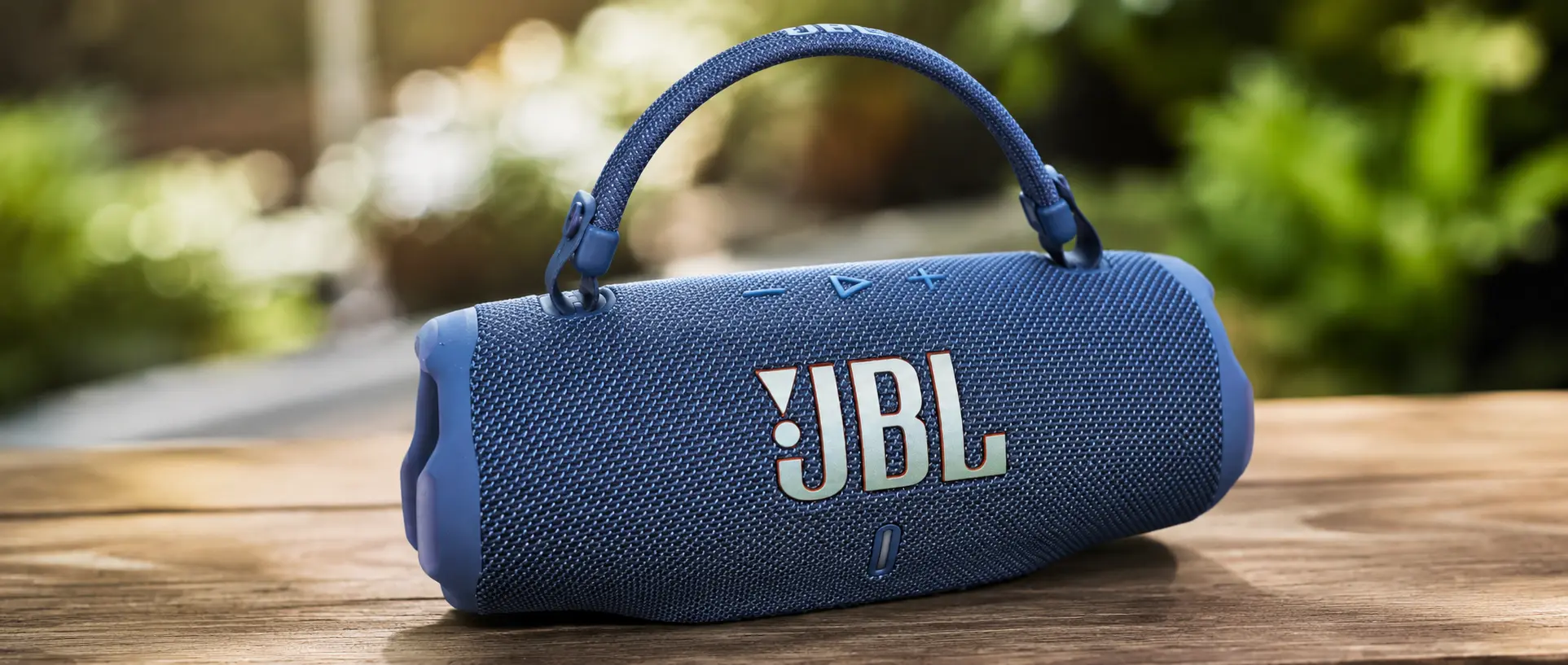
The Charge 6 is the first Charge that sounds like a two-way speaker instead of a very loud one-way one. A dedicated 20 mm tweeter alongside the 53 × 93 mm racetrack woofer takes total output to 45 W and adds treble detail the bass-heavy Charge 5 simply could not produce, all inside an IP68 chassis that is now also certified to survive a 1 m drop. The catch is the runtime: JBL rates 24 hours at 50% volume, but SoundGuys measured 13 hours 15 minutes at a realistic 80 dB, so plan on roughly half the number on the box when you actually use it at party volume.
- Price:
- $149.95
- Maker:
- JBL (Harman International)
Announced 10 March 2025 and on sale in the US from 6 April 2025 at an MSRP of $199.95. As of August 2026 it is $149.95 at Best Buy, with street pricing between $144.99 and $159.95. Model number JBLCHARGE6*AM.
+Pros
- Genuinely louder and cleaner than the Charge 5 — 45 W with a dedicated 20 mm tweeter adds treble detail the Charge 5 lacked
- IP68 water and dust protection plus a 1 m drop certification, among the toughest specifications in the class
- Detachable, repositionable handle/strap is a real ergonomic upgrade over the fixed loop of previous models
- Built-in USB-C powerbank output, plus a 10-minute fast charge that returns 150 minutes of playback
- USB-C lossless wired playback at 24-bit — rare at $150–200
- 7-band custom EQ in the JBL Portable app and Auracast chaining of up to 100 speakers
−Cons
- Rated battery life is optimistic — 13 h 15 min measured at a realistic 80 dB against the 24 h claim
- Playtime Boost audibly degrades sound quality, thinning the bass to buy the extra hours
- No microphone, so there is no speakerphone and no voice assistant
- Auracast breaks compatibility with every PartyBoost and Connect+ JBL speaker you already own
- Sounds flat and tepid at low volumes, and there is no aux input or USB-C cable in the box
01Price and availability
JBL announced the Charge 6 on 10 March 2025 and put it on sale in the US on 6 April 2025 at an MSRP of $199.95, keeping the same slot in the range that every Charge has occupied since the line began. That launch price was the one thing about the speaker most reviewers pushed back on, because the Charge 5 had spent much of its life discounted well below it. Sixteen months later the picture has changed completely: the Charge 6 is $149.95 at Best Buy at the time of writing, with street pricing across retailers ranging from $144.99 to $159.95.
That $50 drop is what moves the Charge 6 from 'good but expensive' to the default answer in its category. At $199.95 it sat awkwardly next to the Sonos Roam 2, which offers Wi-Fi and AirPlay 2 for $179. At $149.95 it lines up directly against the Bose SoundLink Flex 2nd Gen at $149 and undercuts the Roam 2 by $30 while offering more output, a tougher rating and a powerbank the Bose does not have.
There are roughly ten US colourways — Black, Blue, Red, Pink, Purple, Teal, Black/Teal, Sand, White and the Squad camouflage finish — and pricing does not vary between them, though availability of the more unusual colours fluctuates. One thing to budget for: there is no USB-C cable in the box, so if you do not have a spare that supports the 12–20 V / 3 A charging profile, you will be waiting longer than the rated three hours for a full charge.
02Design, durability and the new strap-handle
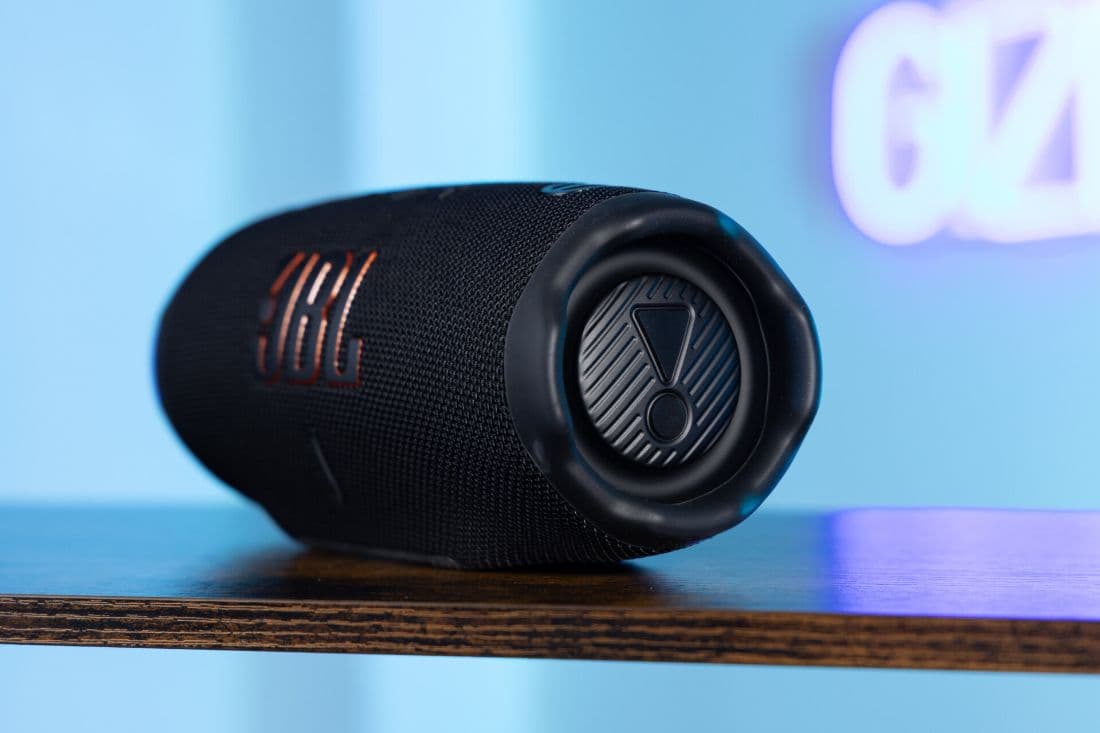
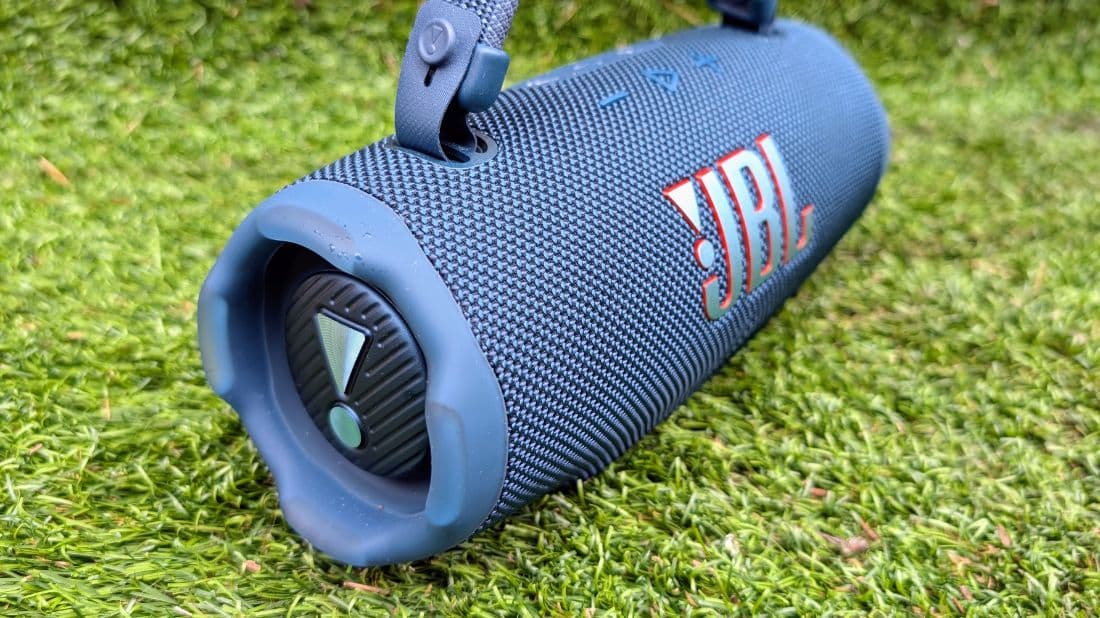
Dimensionally the Charge 6 is almost exactly what a Charge owner expects: 228.8 × 98.5 × 94.0 mm, or 9.0 × 3.9 × 3.7 inches, and 0.99 kg / 2.18 lb with the strap fitted, 0.96 kg without it. That is a size that fits in a cupholder-adjacent gap in a backpack but not in a coat pocket, and a weight that you notice on a long walk without ever resenting. The recycled fabric wrap and recycled plastic end caps are the same materials story JBL has been telling for several generations now, and they have held up well in our long-term Charge units.
The meaningful change is the carry strap. Previous Charge models gave you a short fixed loop that was useful for hanging the speaker and not much else. The Charge 6 uses a detachable, reconfigurable strap-handle that can be repositioned or removed entirely, which sounds like a minor thing until you have carried the speaker one-handed across a beach, hung it from a tent pole and then taken the strap off to sit the speaker flat on a shelf. It is the single most-praised physical change in the reviews we surveyed.
Protection is where JBL has pulled ahead of most of the class. The Charge 6 is IP68 rated — total dust ingress protection, and submersion to 1.5 m for 30 minutes — and is additionally certified drop-proof from 1 m. Rivals in the price band tend to stop at IP67, and while the Soundcore Boom 2 counters with an IPX7 rating and the ability to float, floating does not help with the dust or the drop. This is a speaker you can genuinely stop worrying about.
- Dimensions — 228.8 × 98.5 × 94.0 mm (9.0 × 3.9 × 3.7 in)
- Weight — 0.99 kg / 2.18 lb with strap, 0.96 kg without
- Ingress protection — IP68, submersible to 1.5 m for 30 minutes
- Drop rating — certified to survive a 1 m fall
- Strap — detachable and repositionable, not a fixed loop
- Colours — around ten US finishes including Sand, Teal and Squad camouflage
03Sound: 45 watts, and finally a tweeter
The substantive engineering change in the Charge 6 is the driver array. A 53 × 93 mm racetrack woofer handles the low and midrange with 30 W behind it, and a separate 20 mm tweeter takes the top end with 15 W of its own, for 45 W RMS in total. Dual passive bass radiators sit at each end of the cylinder and do the work you can feel rather than hear. JBL quotes a frequency response of 56 Hz to 20 kHz at −6 dB; TechRadar cites a slightly lower 54 Hz figure, but we would treat JBL's own spec sheet as authoritative here.
In listening, the tweeter is the whole story. The Charge 5 was a bass-forward speaker that rolled off exactly where cymbals, sibilance and string texture live, and no amount of EQ could recover detail the driver was not producing. The Charge 6 resolves hi-hats as individual strikes, keeps vocal consonants intelligible over a busy mix, and holds its composure at volumes where the previous model started to compress everything into one warm block. Reviewers have been near-unanimous on this point: it is clearer and more even-handed than the Charge 5, at higher volume, in a tougher chassis.
Two caveats. First, this speaker is voiced for outdoor and party use, and at low indoor volumes it sounds flat and tepid — the loudness contour that makes it exciting at a barbecue leaves it uninvolving on a kitchen counter at 8 a.m., and the 7-band EQ only partly compensates. Second, we deliberately do not quote a maximum SPL figure: no outlet we reviewed has published a measured loudness number for the Charge 6, and the manufacturer does not specify one. AI Sound Boost, JBL's real-time DSP, works by pushing driver excursion closer to its mechanical limit while watching for distortion, and in practice it does let the speaker play louder cleanly than the wattage alone suggests.
Acoustic hardware at a glance
| Woofer | 53 × 93 mm racetrack driver, 30 W |
|---|---|
| Tweeter | 20 mm dome, 15 W — new for the Charge 6 |
| Passive radiators | Dual, one at each end of the enclosure |
| Total output | 45 W RMS |
| Frequency response | 56 Hz – 20 kHz (−6 dB), per JBL |
| DSP | AI Sound Boost — real-time excursion management |
04Battery and charging: read the small print
The Charge 6 carries a 34 Wh lithium-ion polymer pack — 7.2 V at 4722 mAh — and JBL rates it at 24 hours of playtime, with up to four more hours available through the Playtime Boost toggle for a headline 28 hours. That rating, as JBL states, is measured at 50% volume. SoundGuys ran the speaker at a continuous, realistic 80 dB at 1 m with the stock EQ and recorded 13 hours 15 minutes, which is the number we would plan a day around.
For context, that measurement is not a criticism of this speaker so much as of the industry convention. The same SoundGuys test protocol returned 6 hours 16 minutes from the JBL Flip 7, so the Charge 6 delivers more than twice the real-world endurance of its smaller sibling and comfortably outlasts a typical afternoon. What it does not do is deliver 24 hours at any volume you would choose for a party, and buyers should go in expecting roughly half the box figure.
Charging is well handled. A full refill takes about three hours over USB-C at 12–20 V / 3 A, which TechRadar independently confirmed, and a 10-minute top-up returns 150 minutes of playback — comfortably the most useful battery feature here. The same USB-C port doubles as a powerbank output for phones and tablets, though not for laptops, which draw more than the speaker will supply. Playtime Boost is the one feature we would leave off: it buys its extra four hours by audibly thinning the bass, and the trade is rarely worth it.
Battery endurance — measured versus rated
hours — higher is betterSource: SoundGuys continuous playback at 80 dB / 1 m, stock EQ; JBL rating at 50% volume
05Connectivity: Auracast, USB-C audio, and one painful break
Wireless is Bluetooth 5.4 with A2DP 1.4 and AVRCP 1.6, and the codec list is short: SBC and AAC only. There is no aptX and no LDAC, which is worth knowing if you are coming from an Android phone with a high-bitrate codec you were hoping to use — the Bose SoundLink Flex 2nd Gen does support aptX at the same price. In practice, on a speaker voiced this way and used at these volumes, AAC is not the limiting factor.
The more interesting wired option is USB-C audio. The Charge 6 accepts lossless digital playback over its USB-C port at 24-bit, which is genuinely uncommon in this price band and means you can feed it directly from a laptop or a phone without a Bluetooth encode step at all. Sources disagree on whether the sample rate ceiling is 96 or 192 kHz, so we are not going to state one; what matters is that the wired path is bit-exact and audibly cleaner on dense material than the AAC stream. There is no analogue aux input, and no Wi-Fi, so AirPlay and Spotify Connect are off the table.
Multi-speaker grouping has moved to Auracast, which lets you chain up to 100 compatible speakers or run a stereo pair. The technology is the right long-term bet and works well between Auracast devices. The problem is what it replaces: Auracast is not backward-compatible with PartyBoost or Connect+, so a Charge 5, a Flip 6 or any other older JBL speaker in your house simply cannot be grouped with this one. If your buying reason was extending an existing JBL setup, that is a hard stop, and it is the loudest complaint in an otherwise very positive reception.
06App, features and what is missing
The JBL Portable app is the best it has been. You get a proper 7-band custom EQ rather than a three-slider toy, alongside Signature, Chill and Energetic presets, the Playtime Boost toggle, and over-the-air firmware updates. The EQ is useful specifically because the Charge 6 has a tweeter to shape — pulling back the upper bass and lifting 4–8 kHz slightly makes the speaker considerably more listenable indoors, which is exactly the scenario where the stock tuning disappoints.
The omission that will catch people out is the microphone, or rather the complete absence of one. There is no speakerphone function and no voice assistant support of any kind, which is unusual at this price — the Bose SoundLink Flex 2nd Gen and the Sonos Roam 2 both include a mic. For a speaker that spends its life outdoors and in bathrooms this is defensible, and it removes a privacy question, but if you were planning to take calls in the kitchen you need a different product.
The other gaps are smaller but worth listing. There is no aux input, so a device without USB-C audio or Bluetooth cannot connect at all. There is no Wi-Fi, so no AirPlay 2, no Spotify Connect and no multi-room beyond Auracast. And there is no USB-C cable in the box, which on a $150 speaker that ships with a fast-charge specification feels like a cost saving too far.
- 7-band custom EQ plus Signature, Chill and Energetic presets
- Playtime Boost toggle — adds up to 4 h at a clear cost to bass weight
- Over-the-air firmware updates via the JBL Portable app
- No microphone — no speakerphone, no voice assistant
- No aux input, no Wi-Fi, no AirPlay 2 or Spotify Connect
- No USB-C cable supplied in the box
07How it compares
At $149.95 the Charge 6 lands in the most crowded price band in portable audio, and each rival wins on a different axis. The Bose SoundLink Flex 2nd Gen matches it on price, adds a microphone with multipoint and aptX support, and is smaller — but it is IP67 rather than IP68, has no powerbank, and does not claim anything like the Charge 6's output. The Sonos Roam 2 at $179 is the one to buy if you are already inside a Sonos system, because Wi-Fi, AirPlay 2 and multi-room are things the JBL structurally cannot do, but its roughly 10-hour rating is the weakest here.
The Soundcore Boom 2 is the aggressive option: $129.99 for an 80 W 2.1 system with a dedicated subwoofer, a 24-hour claim and an IPX7 rating that lets it float. It is louder and bassier for less money. What it does not have is the Charge 6's tonal balance, its build certification, its USB-C lossless input or JBL's app polish, and Soundcore's runtime claim comes with the same 'measured at a convenient volume' caveat as JBL's.
Critical reception reflects that spread. What Hi-Fi awarded a rare 5/5, TechRadar scored 4.5 to 5 out of 5 across its categories — design, usability and value all took full marks — and called the speaker excellent value; SoundGuys landed on 8.4/10 and Stereo Guide on a composite 84% (tonal 8/10, bass and dynamics 8/10, usability 9/10, value 8.8/10), while Tom's Guide marked it Recommended. The typical band is 4.5/5 to 5/5, and the recurring caveat across all of them is the same one we found: expect roughly half the claimed runtime at party volume.
Head to head
| Specification | JBL Charge 6 | Bose SoundLink Flex 2nd Gen | Sonos Roam 2 | Soundcore Boom 2 |
|---|---|---|---|---|
| Price (Aug 2026) | $149.95 | $149 | $179 | $129.99 |
| Rated battery | 24 h (13 h 15 min measured at 80 dB) | ~12 h | ~10 h | ~24 h |
| Rated output | 45 W RMS (30 W + 15 W) | Not published | Not published | 80 W, 2.1 with subwoofer |
| Protection | IP68 + 1 m drop | IP67 | IP67 | IPX7, floats |
| Microphone | None | Yes | Yes | None |
| Notable wireless | Auracast, SBC/AAC, USB-C lossless | aptX, Bluetooth multipoint | Wi-Fi, AirPlay 2 | Bluetooth party grouping |
Full specifications
Audio
| Woofer | 53 × 93 mm racetrack driver, 30 W |
|---|---|
| Tweeter | 20 mm dome, 15 W |
| Passive radiators | Dual bass radiators |
| Total output | 45 W RMS |
| Frequency response | 56 Hz – 20 kHz (−6 dB), per JBL spec sheet |
| Processing | AI Sound Boost real-time DSP |
| Maximum SPL | Not specified by JBL and not independently measured |
| Microphone | None — no speakerphone, no voice assistant |
Battery and charging
| Battery | 34 Wh Li-ion polymer (7.2 V / 4722 mAh) |
|---|---|
| Rated playtime | 24 h at 50% volume; 28 h with Playtime Boost |
| Measured playtime | 13 h 15 min at 80 dB / 1 m, stock EQ (SoundGuys) |
| Charge time | Approximately 3 h at 12–20 V / 3 A |
| Fast charge | 10 minutes for 150 minutes of playback |
| Powerbank output | USB-C out for phones and tablets — not laptops |
| In the box | No USB-C cable supplied |
Connectivity
| Bluetooth | 5.4 |
|---|---|
| Profiles | A2DP 1.4, AVRCP 1.6 |
| Codecs | SBC and AAC only — no aptX, no LDAC |
| Multi-speaker | Auracast — up to 100 speakers, plus stereo pairing |
| Legacy grouping | Not compatible with PartyBoost or Connect+ |
| Wired audio | USB-C lossless playback, 24-bit |
| Analogue input | None — no 3.5 mm aux |
| Wi-Fi | None — no AirPlay 2 or Spotify Connect |
Physical and durability
| Dimensions | 228.8 × 98.5 × 94.0 mm (9.0 × 3.9 × 3.7 in) |
|---|---|
| Weight | 0.99 kg / 2.18 lb with strap; 0.96 kg without |
| Ingress protection | IP68 — dust-tight, 1.5 m for 30 minutes |
| Drop rating | Certified drop-proof from 1 m |
| Carry strap | Detachable and repositionable handle/strap |
| Materials | Recycled fabric wrap and recycled plastics |
| Colours | Around ten US finishes, including Sand, Teal and Squad camouflage |
| Model number | JBLCHARGE6*AM |
Verdict
JBL had a straightforward problem with the Charge line: it was loud, it was tough, and it was tonally lopsided. The Charge 6 answers that with hardware rather than DSP trickery. Adding a 20 mm tweeter to the 53 × 93 mm racetrack woofer and pushing total output to 45 W — 30 W for the woofer, 15 W for the tweeter — changes the character of the speaker rather than just its volume. Cymbals, string texture and consonants land where the Charge 5 gave you a warm smear, and the dual passive radiators still keep the low end substantial enough that nobody will call it thin at a barbecue.
The rest of the package is the most complete in its price class. IP68 with a 1 m drop rating is among the toughest certification set in the category, the detachable strap-handle is a genuine ergonomic improvement rather than a styling change, the built-in powerbank will refill a phone, and USB-C lossless wired playback at 24-bit is close to unheard of at $150. Add a 7-band EQ in the JBL Portable app and Auracast chaining of up to 100 speakers and you have a feature sheet that reads like a much more expensive product.
What keeps this off a higher score is honesty about endurance and a couple of pointed omissions. The rated 24 hours is measured at 50% volume; at a realistic 80 dB the true figure is 13 hours 15 minutes, and Playtime Boost buys its extra four hours by thinning the bass in a way you can hear. There is no microphone at all, so no calls and no voice assistant, and Auracast means none of your existing PartyBoost or Connect+ JBL speakers will pair with it. At $149.95 those are trade-offs rather than dealbreakers, and this remains the default recommendation for a rugged mid-size portable.
Buy it if
- Anyone who wants one rugged speaker for the pool, the beach and the kitchen counter
- Charge 5 owners who have been irritated by the missing treble detail
- Listeners who want a wired lossless option from a laptop or phone over USB-C
- Buyers who value a powerbank output and fast charging on trips away from mains power
Skip it if
- You need speakerphone or voice assistant support — there is no microphone at all
- You already own PartyBoost or Connect+ JBL speakers and want to keep grouping them
- You mostly listen quietly indoors, where this speaker sounds flat and tepid
- You want a genuine 24-hour party speaker without carrying a charger
Sources and further reading
- JBL — Charge 6 official specification sheet (PDF)
- SoundGuys — JBL Charge 6 review and battery measurement
- What Hi-Fi — JBL Charge 6 review
- TechRadar — JBL Charge 6 review
- Stereo Guide — JBL Charge 6 review
Figures quoted from third-party laboratories are attributed inline. Prices were correct at the time of publication and change often.