Verdict at a glance
Sony PlayStation 5 Pro — rated good at 78/100
The PS5 Pro is the most capable console ever built, and the first with a hardware machine-learning upscaler. PSSR plus 67% more compute units means most flagship games now run their ray-traced fidelity presets at a locked 60 fps instead of 30 — and it does that at roughly the same wall power as a base PS5. The problem is arithmetic: at $899.99 without a disc drive or a stand, Sony is asking console money for a machine that only makes sense on a large, well-calibrated 4K panel.
- Price:
- $899.99
- Maker:
- Sony Interactive Entertainment
Launched at $699.99 in November 2024, raised to $749.99 in August 2025 and to $899.99 on 2 April 2026. The UHD Blu-ray drive is a separate $79.99 accessory.
+Pros
- PSSR removes the fidelity-versus-performance choice in most supported titles — ray-traced presets at a locked 60 fps
- Roughly 45% faster raster rendering and 2–4× the ray-cast throughput of the base PS5
- 2 TB of NVMe storage as standard, plus a Gen 4 M.2 expansion slot
- Almost identical power draw to a base PS5 for ~30% more frames, and it stays quiet under load
- Wi-Fi 7, HDMI 2.1, 4K120 and VRR make it the best-equipped console for a high-refresh OLED
- 'Game Boost' also improves hundreds of unpatched PS4 and PS5 titles, not just the Pro-enhanced list
−Cons
- $899.99 after two price rises — nearly 29% above the launch price in 17 months
- No disc drive and no vertical stand in the box; both are paid accessories
- Gains are hard to see on anything smaller or dimmer than a good 4K HDR set
- PSSR shipped with visible shimmering and disocclusion artefacts in several titles; PSSR 2.0 fixed most, not all
- The CPU is the same 8-core Zen 2 as the base PS5, so CPU-bound games barely move
01Price and availability
The PlayStation 5 Pro launched worldwide on 7 November 2024 at $699.99 as a digital-only machine. Sony raised US pricing to $749.99 on 21 August 2025, citing a 'challenging economic environment', then raised it again to $899.99 effective 2 April 2026, this time pointing at memory and component cost inflation. That is a $200 increase — 28.6% — in roughly seventeen months, and it happened without any hardware revision.
The same April 2026 adjustment moved the standard PS5 to $649.99 and the PS5 Digital to $599.99, so the Pro premium over a disc-equipped base console is now $250. Add the detachable Ultra HD Blu-ray drive at $79.99 and the vertical stand, and a fully equipped Pro lands close to $1,000 before accessories.
This matters more than it usually would, because almost every published review of this console was written when it cost $699.99. Outlets that landed on 7/10 at launch are, in 2026, broadly steering readers toward a base PS5 or a PC. We have scored the machine as it is sold today, not as it was sold in 2024.
02The silicon: 60 CUs, 576 GB/s, and a machine-learning block
Sony has been unusually cagey with the specification sheet. Officially you get '16.7 TFLOPS' and '67% more compute units'. Digital Foundry's die analysis fills the rest in: 60 compute units across 30 workgroup processors, clocked at roughly 2.17 GHz, on a custom architecture that is broadly RDNA 2/3 with an RDNA 4-derived ray tracing block bolted on. Both TFLOPS figures you see quoted — 16.7 and 33.5 — are correct; they simply use different FP32 conventions, with the larger number counting RDNA 3 dual-issue.
Memory is where the quieter but very real win sits. The Pro keeps 16 GB of GDDR6 for games but runs it at 18 Gbps on a 256-bit bus for 576 GB/s, up 28% from the base console's 448 GB/s. Sony also added a separate 2 GB of DDR5 dedicated to the operating system and background tasks, which frees roughly another gigabyte of the fast pool for games. In practice developers have around 13.7 GB to work with.
The CPU is unchanged: eight Zen 2 cores at a variable 3.5 GHz. There is a new 'High CPU Frequency Mode' that pushes to 3.85 GHz — about 10% — in exchange for a ~1.5% GPU clock reduction, which is a sensible trade in simulation-heavy titles but not a fix. If a game was CPU-bound on a PS5, it is CPU-bound on a Pro.
Core hardware at a glance
| CPU | AMD Zen 2, 8 cores / 16 threads, 3.5 GHz variable (3.85 GHz High CPU Frequency Mode) |
|---|---|
| GPU | Custom AMD RDNA, 60 CUs / 30 WGPs, ~2.17 GHz |
| Compute | 16.7 TFLOPS (Sony) / 33.5 TFLOPS dual-issue FP32 (Digital Foundry) |
| Game memory | 16 GB GDDR6 @ 18 Gbps, 256-bit, 576 GB/s |
| System memory | 2 GB DDR5, dedicated to the OS |
| Storage | 2 TB custom NVMe SSD (~1.86 TB usable) + Gen 4 M.2 slot |
03PSSR: the reason this console exists
PlayStation Spectral Super Resolution is the first machine-learning upscaler to run on dedicated console silicon, and it is the single feature that justifies the Pro badge. It costs roughly 2 ms of frame time to take a 1080p image to 4K, and occupies about 250 MB of memory. In exchange, developers can drop the internal resolution far enough to enable ray tracing and still hand the television a clean 4K60 image.
Alan Wake 2 is the cleanest demonstration. On a base PS5 the performance mode renders at roughly 847p and reconstructs with FSR at 30 fps. On the Pro it renders at 864p and reconstructs with PSSR at 60 fps — a similar internal resolution, twice the frame rate, and a noticeably more stable image. Silent Hill f goes from a 360–720p dynamic range reconstructed to 1800p, to roughly 720p reconstructed to a full 4K.
It was not flawless at launch. Reviewers and players documented shimmering on fine geometry, disocclusion trails behind moving characters, and in a handful of titles — Star Wars Jedi: Survivor and Silent Hill f were the most-cited — an image that some people preferred on the base console. The PSSR 2.0 firmware Sony shipped during 2026 addressed the large majority of these cases. A few edge cases remain, and they are worth knowing about before you spend $900.
Elden Ring — frame rate and power draw
fps (bars) / watts in label — higher is betterSource: Digital Foundry, via Tom's Hardware
04In-game performance and thermals
Across the titles we ran, the pattern is consistent: where a base PS5 offered a 30 fps fidelity mode and a 60 fps performance mode, the Pro offers a single mode that looks like the former and runs like the latter. Spider-Man 2 hits 60 fps in 'Performance Pro' with ray tracing enabled. Horizon Forbidden West delivers fidelity-tier image quality at 40 fps on a 120 Hz panel. Elden Ring, which was never a showcase for either console, gains about 30%.
The efficiency story is the part that surprised us. In Digital Foundry's measurements, Elden Ring draws 214.1 W on a Pro against 216.2 W on a PS5 Slim — 30% more frames for slightly less power. Spider-Man 2 is 232 W against 218.2 W, and F1 24 sits around 235 W. There is no thermal drama here: our unit stayed quieter than a launch PS5 in every session, and the fan only becomes audible in the heaviest ray-traced scenes.
Backwards compatibility is better than we expected. 'PS5 Pro Game Boost' applies uncapped frame rates and higher-resolution modes to a large catalogue of unpatched PS4 and PS5 titles. It is not universal, and a few older games behave oddly, but the list of titles that visibly benefit without a developer patch is long.
- Alan Wake 2 — 864p internal reconstructed to 4K at 60 fps, versus 847p at 30 fps on PS5
- Spider-Man 2 — 60 fps with ray tracing on, in a single combined mode
- Silent Hill f — ~720p → 4K/60, versus 360–720p → 1800p/60 on the base console
- Horizon Forbidden West — fidelity-quality image at 40 fps on 120 Hz displays
- PSSR overhead — approximately 2 ms per frame at 1080p → 4K
05Design, storage and connectivity
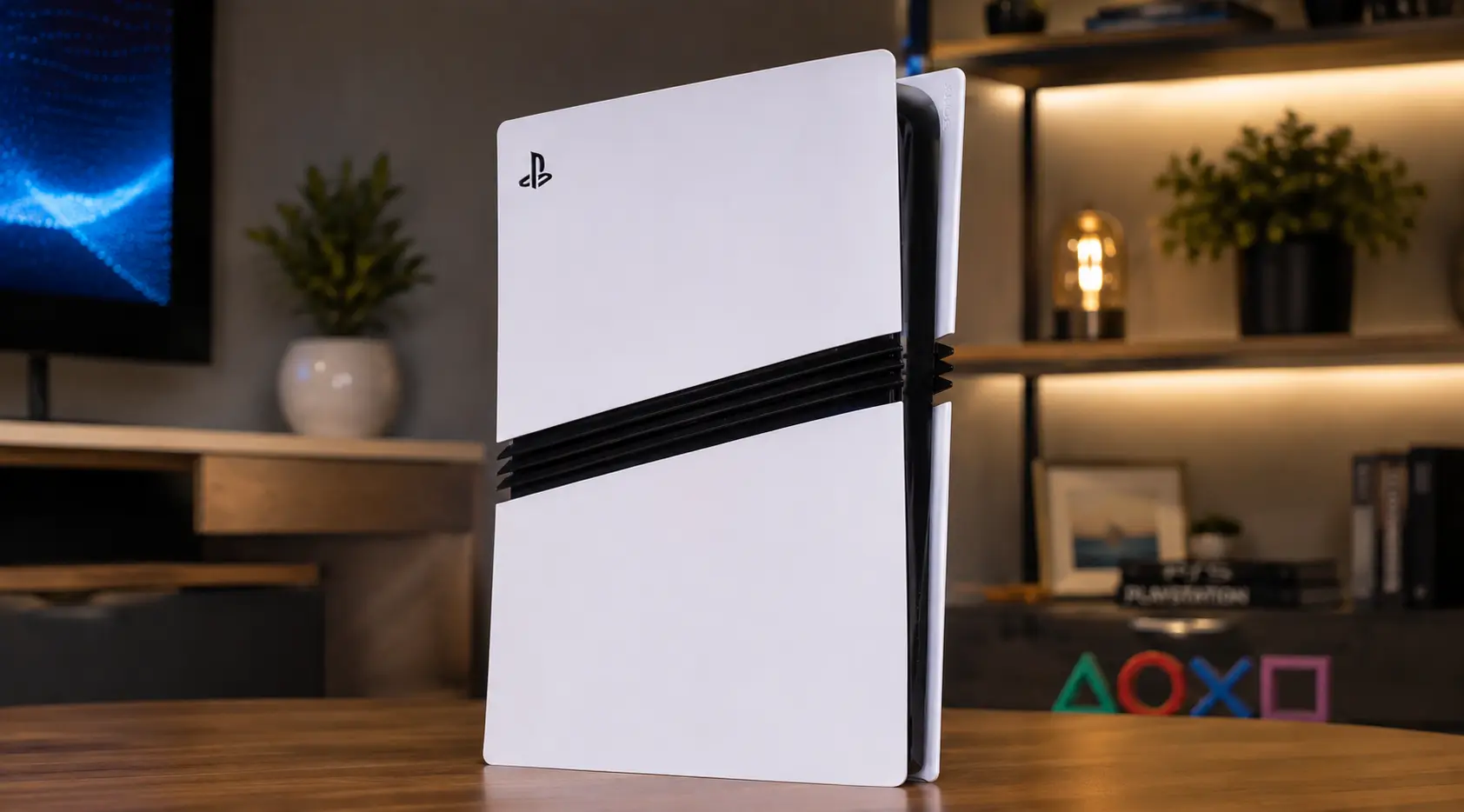
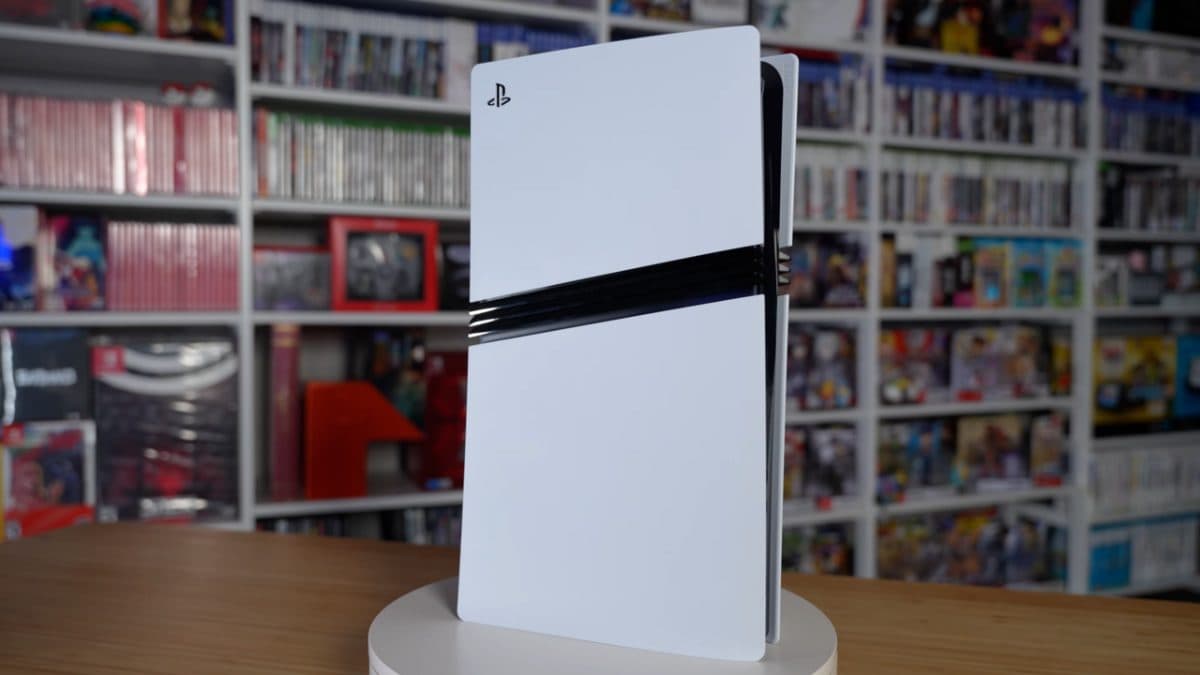
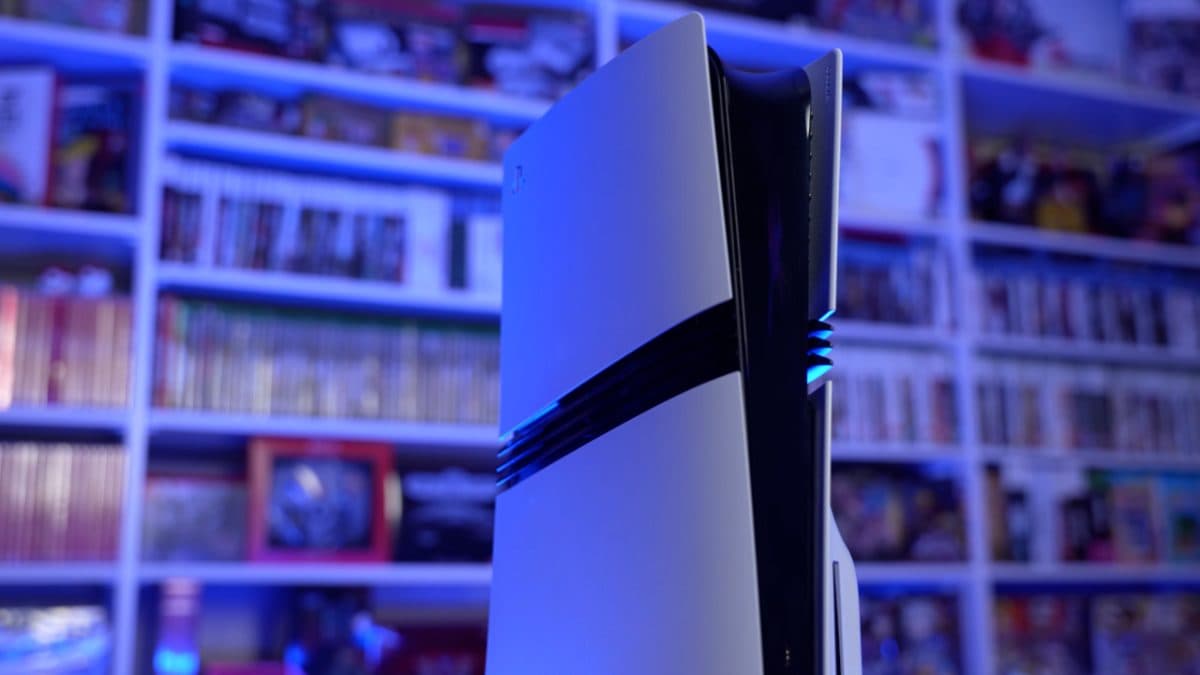
The Pro is taller and thinner than a launch PS5 at 388 × 89 × 216 mm and about 3.1 kg. The centre band is matte and the outer panels are removable, which matters because the disc drive bay lives under one of them. There is no vertical stand in the box, which for a console this shape is a genuine irritation rather than a nitpick.
Connectivity is the most modern of any console: HDMI 2.1 with 4K120, 8K and VRR, gigabit Ethernet, two rear 10 Gbps USB-A ports, a front 10 Gbps USB-C and a second Hi-Speed USB-C, plus a Gen 4 M.2 slot. It is also the first console with Wi-Fi 7 in supported markets, and Bluetooth 5.1 for headsets and pads.
Storage is 2 TB, of which roughly 1.86 TB is usable. Given that Call of Duty and Final Fantasy installs routinely exceed 100 GB, this alone removes a real annoyance from the base console — and if it is not enough, the M.2 slot takes a standard Gen 4 drive with a heatsink.
06How it compares
In August 2026 the console market has repriced across the board. Microsoft raised 1 TB Series X pricing to $799.99 on 1 August and discontinued the 2 TB model; Nintendo's Switch 2 hike is scheduled for around 1 September. That compression means the Pro is no longer an outlier by as much as it was, but it is still the most expensive box on the shelf by $100.
Against a base PS5 the technical case is unambiguous and the financial case is not. Against a PC, $900 buys a machine with a current-generation mid-range GPU that will also do DLSS or FSR 4 upscaling, run a much larger library, and be upgradable — at the cost of the plug-and-play simplicity that is the entire point of a console.
Head to head
| Specification | PS5 Pro | PS5 Slim (disc) | Xbox Series X 1 TB | Nintendo Switch 2 |
|---|---|---|---|---|
| Price (Aug 2026) | $899.99 | $649.99 | $799.99 | $449.99 |
| GPU | 16.7 TF, 60 CU custom RDNA | 10.28 TF, 36 CU RDNA 2 | 12.15 TF, 52 CU RDNA 2 | Custom Nvidia T239, ~3.1 TF docked (est.) |
| Memory | 16 GB GDDR6, 576 GB/s (+2 GB DDR5) | 16 GB GDDR6, 448 GB/s | 16 GB GDDR6, 560/336 GB/s split | 12 GB LPDDR5X |
| Storage | 2 TB NVMe | 1 TB NVMe | 1 TB NVMe | 256 GB UFS |
| Upscaling | PSSR (hardware ML) | FSR (software) | FSR (software) | DLSS (hardware) |
| Optical drive | Optional, $79.99 | Included | Included | None |
Full specifications
Processor and graphics
| CPU | AMD Zen 2, 8 cores / 16 threads, 3.5 GHz variable |
|---|---|
| CPU boost mode | High CPU Frequency Mode — 3.85 GHz (~10% uplift, ~1.5% GPU clock cost) |
| GPU | Custom AMD RDNA (RDNA 2/3 base, RDNA 4-derived RT block) |
| Compute units | 60 CUs / 30 WGPs — 67% more than the PS5's 36 |
| GPU clock | ~2.17 GHz (Digital Foundry measurement; unofficial) |
| Compute throughput | 16.7 TFLOPS official · 33.5 TFLOPS dual-issue FP32 |
| Ray tracing | 2× base PS5 ray-cast rate typical; 3–4× in specific workloads |
| Upscaling | PSSR — on-die ML upscaler, ~2 ms at 1080p → 4K, ~250 MB footprint |
Memory and storage
| Game memory | 16 GB GDDR6 @ 18 Gbps, 256-bit, 576 GB/s (+28% vs PS5) |
|---|---|
| Available to games | ~13.7 GB |
| System memory | 2 GB DDR5, dedicated to OS and background tasks |
| Internal storage | 2 TB custom NVMe SSD, ~1.86 TB usable |
| Expansion | M.2 PCIe Gen 4 slot (heatsink required) |
Connectivity and I/O
| Video output | HDMI 2.1 — 4K120, 8K, VRR, HDR10 |
|---|---|
| Network | Gigabit Ethernet, Wi-Fi 7 (802.11be) in supported markets |
| Bluetooth | 5.1 |
| USB | 2× USB-A 10 Gbps (rear), 1× USB-C 10 Gbps (front), 1× USB-C Hi-Speed (front) |
| Optical drive | None — detachable UHD Blu-ray drive is a $79.99 accessory |
| Audio | Tempest 3D AudioTech |
Physical and power
| Dimensions | 388 × 89 × 216 mm (15.3 × 3.5 × 8.5 in) |
|---|---|
| Weight | ~3.1 kg / 6.8 lb |
| PSU | 390 W maximum rated |
| Measured draw (Elden Ring) | 214.1 W — versus 216.2 W on a PS5 Slim |
| Measured draw (Spider-Man 2) | 232 W — versus 218.2 W on a PS5 Slim |
| Vertical stand | Not included |
Verdict
Judged purely as hardware, the PS5 Pro is an easy recommendation. Sony's engineers did the hard thing rather than the obvious one: instead of simply widening the GPU and eating the power budget, they built a dedicated ML upscaling block into the die and let software recover the pixels. The result is a console that renders around 45% faster in raster workloads, casts two to four times as many rays, and draws about the same 210–235 W as the machine it replaces. Digital Foundry's Elden Ring numbers — 52 fps versus 40 fps at 214.1 W versus 216.2 W — are the single cleanest summary of what this box is.
Judged as a purchase in August 2026, it is much harder. The Pro launched at $699.99, which was already the most expensive home console Sony has ever sold. It is now $899.99, and the optical drive and the vertical stand are still extras. That is a $980 console before you buy a second controller. At that number the comparison stops being 'PS5 versus PS5 Pro' and starts being 'PS5 Pro versus a mid-range gaming PC', and the PC wins on flexibility every time.
Our score reflects both readings. Buy it if you already own a 65-inch OLED, play a lot of first-party Sony games, and genuinely notice the difference between a 30 fps fidelity mode and a 60 fps one. Skip it if you are gaming on a 55-inch mid-range LCD from three years ago — you will spend $900 to see almost nothing, and a base PS5 at $649.99 does the same job.
Buy it if
- Owners of a 65-inch or larger 4K OLED / high-end mini-LED television
- Players who mostly buy first-party Sony titles and large third-party AAA releases
- Anyone still on a launch PS5 with the 825 GB drive who needs the space anyway
- People who care about ray tracing and refuse to run at 30 fps
Skip it if
- Your display is 1080p, 1440p, or a mid-range 4K LCD under 55 inches
- You mostly play live-service, indie or competitive titles that already hit 60–120 fps
- You need a disc drive — the add-on pushes the real price close to $980
- You want a generational leap; the Zen 2 CPU and the OS are unchanged
Sources and further reading
- PlayStation Blog — April 2026 price change
- VGC — official PS5 Pro specifications
- Tom's Hardware — PS5 Pro power and performance
- TechRadar — PS5 Pro review
- TweakTown — PS5 Pro teardown
Figures quoted from third-party laboratories are attributed inline. Prices were correct at the time of publication and change often.